
Strength Is the Secret to Aging Well
There comes a point — usually somewhere after 40 — when you start to feel it:
The stairs take more effort. Your energy dips. Your joints complain more than they used to.
And maybe you just don’t feel as strong in your body as you once did.
You might think it’s just “getting older.”
But more often, it’s something else: you’re losing muscle.
Most people over 40 focus on losing weight, eating better, or doing more cardio.
But few realize that building and maintaining strength is the real game changer — not just for fitness, but for longevity, independence, and everyday life.
Muscle isn’t about looking ripped.
It’s about moving with confidence, avoiding injury, and aging on your own terms.
In this post, we’ll break down:
- Why muscle matters more than ever after 40
- What kind of strength you actually need
- Common myths that hold people back
- And simple ways to start — even if you feel stiff, busy, or brand new to training
Because if you’re over 40, strength isn’t optional anymore.
It’s your body’s insurance policy for the decades ahead.
1. Why Strength Becomes Critical After 40
You’ve probably heard that metabolism slows with age.
But here’s what they don’t always tell you:
One of the biggest reasons for that slowdown is muscle loss — not age itself.
Starting in your 30s, your body gradually begins to lose lean muscle mass in a process called sarcopenia.
If you don’t actively resist it, that loss accelerates every decade — and it affects far more than just how you look.
Here’s what losing muscle actually means over time:
Less Muscle =
- Decreased metabolism and easier weight gain
- Increased joint strain and injury risk
- Weaker posture, balance, and coordination
- Less energy and strength for daily life
- Higher risk of insulin resistance, bone loss, and frailty later in life
On the flip side…
More Muscle =
- Better blood sugar control and hormone regulation
- Greater protection for joints and bones
- Faster recovery from stress, injury, or illness
- Improved mobility, independence, and quality of life
And here’s the best part:
It’s never too late to start building strength.
You can regain lost muscle and build new strength well into your 50s, 60s, 70s — and beyond.
All it takes is consistency, the right movements, and a mindset shift:
Don’t train to look young.
Train to move well — and stay free.
2. Common Myths That Keep Midlifers Weak
Many people in midlife avoid strength training because they believe it’s:
- Too intense
- Too risky
- Too late
- Or just “not for people like me”
Let’s bust those myths — because they’re keeping too many people stuck in weak, stiff, and tired bodies that are capable of much more.
❌ Myth #1: “I don’t want to get bulky.”
Reality: That’s not going to happen — especially after 40.
Building large muscle mass takes years of focused, heavy training and high-calorie eating.
What you will get is a leaner, more toned, and more capable body.
❌ Myth #2: “Strength training is dangerous at my age.”
Reality: The real danger is not training at all.
Strength training (done properly) actually strengthens bones, joints, and tissues — helping prevent injury, falls, and fractures.
❌ Myth #3: “I’m too old to start.”
Reality: Studies show people in their 60s, 70s, even 80s can build strength, improve balance, and regain lost function.
You are never too old to get stronger.
❌ Myth #4: “I already walk / bike / do yoga — that’s enough.”
Reality: Those are great habits, but they don’t replace resistance training.
You need progressive loading — challenging your muscles with more than body weight — to stimulate real strength.
The truth?
Strength training after 40 isn’t risky — it’s necessary.
And the sooner you begin, the longer you get to enjoy the benefits.
3. Functional Strength: What You Really Need
Let’s be honest — most of us over 40 aren’t training to deadlift 200 kg or show off in the mirror.
What we really want is to move well, feel strong, and handle life with less pain, stress, and effort.
That’s where functional strength comes in.
It’s not about looking strong.
It’s about being able to do real-life things with more ease, energy, and confidence.
What is functional strength?
It’s the kind of strength that improves:
- Mobility: getting up and down from the floor
- Stability: climbing stairs or walking on uneven ground
- Endurance: carrying groceries or your kid without strain
- Posture: sitting or standing upright without tension
- Resilience: preventing injuries and bouncing back faster when they happen
Real-world examples of functional strength:
| Movement | What it helps with |
|---|---|
| Squats | Getting out of a chair, car, or off the floor |
| Rows or Pulls | Improving posture and protecting your shoulders |
| Core work | Supporting your spine and reducing back pain |
| Step-ups | Navigating stairs and improving balance |
| Farmer’s carry | Building grip strength — a powerful longevity marker |
These aren’t just “gym moves.”
They’re life moves — and they become more important with every year that passes.
The good news?
You don’t need to lift heavy or have perfect form to start.
What matters is practicing these movements with control, consistency, and care — even at bodyweight or with bands.
Functional strength is what lets you keep doing the things you love —
and keeps you independent, mobile, and free long into the future.
4. How to Start (Even If You’re Stiff, Busy, or New)
Starting strength training after 40 can feel intimidating — especially if:
- Your body feels tight or fragile
- You don’t have much free time
- You’ve never lifted a weight in your life
But here’s the truth:
You don’t need to be “ready” — you just need to begin.
And the best way to start is with simple, joint-friendly, functional movements that reconnect you with your body.
Start Small, Start Safe
You don’t need a gym, fancy gear, or even weights.
Just your body, gravity, and a few minutes a couple times a week.
Here’s what that could look like:
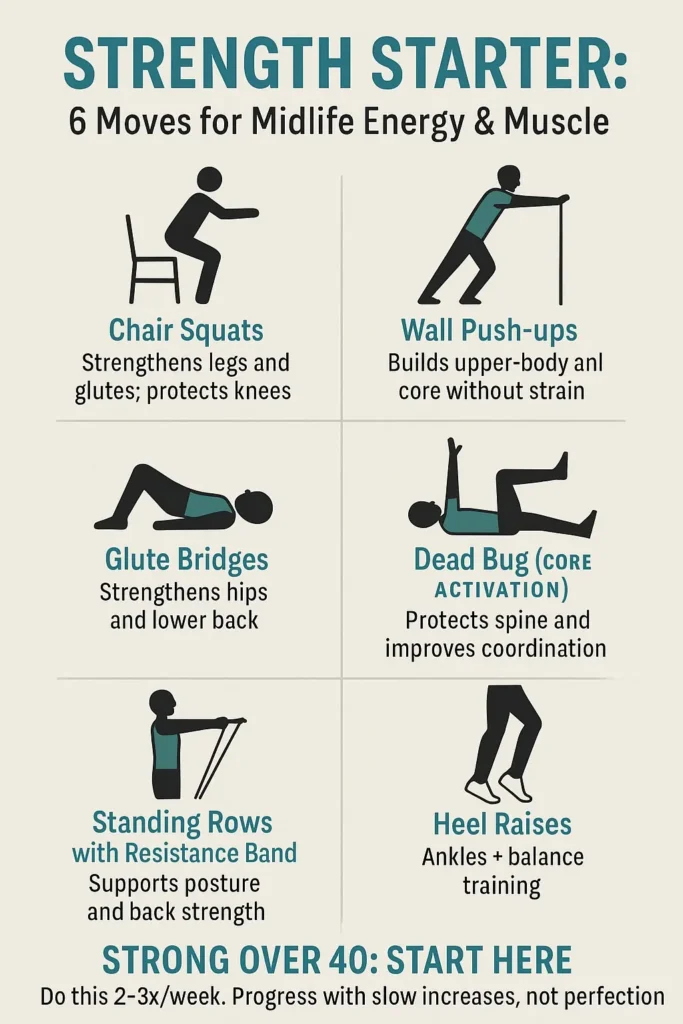
Basic Midlife Strength Moves:
- Chair Squats – Sit and stand with control (start with support if needed)
- Wall Push-ups – Strengthen arms and chest without strain
- Glute Bridges – Wake up the posterior chain and support your spine
- Bird-Dogs – Core + balance without crunches
- Step-ups (low height) – Boost leg strength and stability
- Resistance Band Rows – Improve posture and protect shoulders
Time Commitment:
- Just 2–3 sessions a week
- 15–30 minutes is enough to build momentum
- Focus on form > speed
- Rest between movements — this isn’t bootcamp
Remember:
- Mobility comes first – warm up with 1–2 minutes of movement
- Track your wins – consistency > perfection
- You will feel stronger within 2–4 weeks (often sooner)
This isn’t about pushing hard.
It’s about building strength that protects and supports your real life.
Conclusion: Muscle Is Your Midlife Advantage
After 40, your body starts whispering things you used to ignore.
A little more stiffness.
A little less energy.
A growing sense that things don’t bounce back like they used to.
The good news? You can do something about it.
Strength is your advantage now — not your burden.
It’s what keeps you upright, mobile, pain-free, and independent.
It’s what lets you say yes to adventure, parenting, work, and the life you actually want.
And here’s the best part:
You don’t need to train like an athlete. You just need to train like someone who plans to keep living well. Start where you are. Use what you have. Build one small rep at a time. Because strength after 40 isn’t optional. It’s the foundation for everything else.
❓ FAQ: Strength Training After 40
Is it safe to start strength training after 40 (or 50+)?
Yes — and it’s one of the best things you can do for your health. Start with bodyweight or resistance bands and focus on good form. It’s never too late to build strength.
How often should I train to see results?
Just 2–3 short sessions per week is enough to build strength, support your joints, and improve energy. You don’t need to train daily — consistency matters more than intensity.
I’ve never done strength training. Where do I begin?
Start with basic functional movements like chair squats, wall push-ups, glute bridges, and resistance band rows. You don’t need a gym or fancy gear — just your body and gravity.
Will strength training make me bulky?
No — especially not after 40. It takes very intense training and high-calorie eating to build bulky muscle. What you’ll build instead is lean, functional strength.
What if I’m stiff or have joint pain?
That’s all the more reason to start. Focus on joint-friendly, low-impact movements and pair strength with mobility. Start slow. Movement often reduces pain over time.